What is surgical machine intelligence?
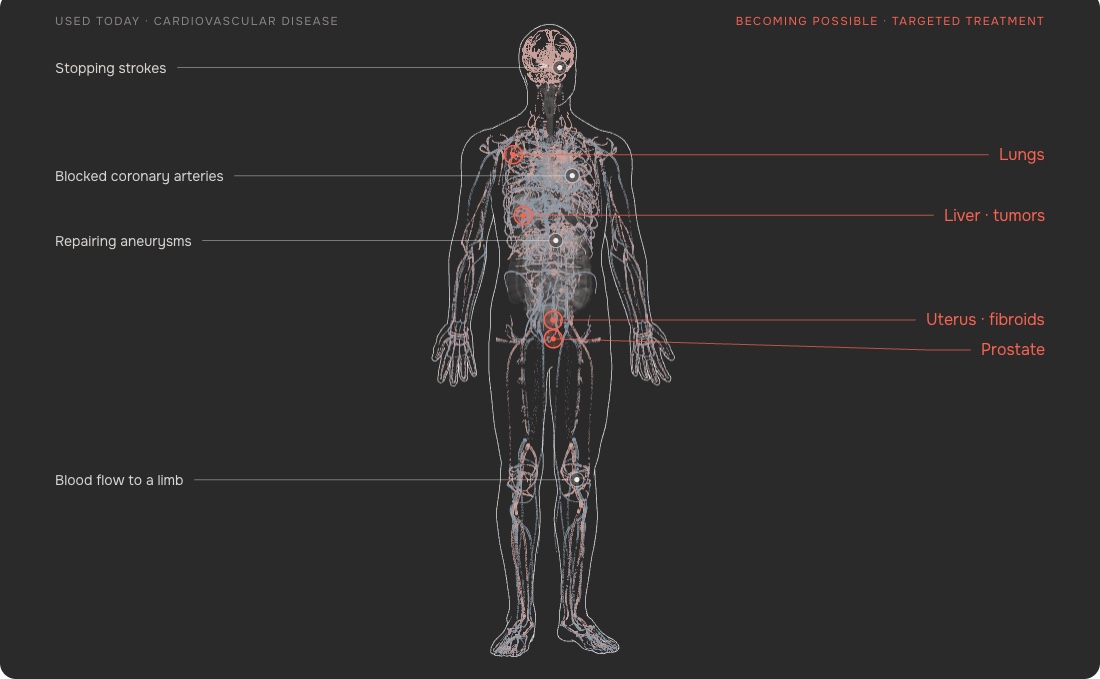
Advances in surgery have made it possible to reach deep inside the body through little more than the puncture of a needle, using the vascular network as a route to disease. No longer are exploratory surgeries with major incisions and requiring significant dissection as well as organ manipulation required to reach the hidden regions in which disease may live.
At Mosaic, we’re doubling down on these trends. We believe endovascular access will play an increasingly important role in the future of surgery: making vascular networks easier to navigate will expand the range of therapies able to be delivered precisely where they are needed. All of it with less trauma, less potential side effects, and across more sites of care.
Today, however, navigating complex, unpredictable vascular networks requires extraordinary skill, expensive imaging infrastructure, and hazardous technology. Physicians mostly rely on fluoroscopy - live X-ray imaging - to guide instruments through anatomy they cannot see directly. This exposes patients and clinical teams to near-continuous ionizing radiation. And it limits the sites in which such care can be delivered to those with significant fluoroscopic imaging infrastructure.
At Mosaic, we believe the solution is to build reliable surgical machine intelligence: the integration of AI models with robotic systems and internal sensing to understand, reason through, and physically navigate complex real-world environments. This physical and spatial intelligence bridges the gap between manual endovascular challenges and robotic automation by translating sensor data into real-time 3D awareness and control. In so doing, we also aim to reduce and ultimately replace dependence on ionizing radiation for vascular navigation.
Consider a physician guiding a catheter from an artery in the leg toward the vessels supplying the heart. From outside the patient, the physician threads and rotates a long, flexible tube through a needle puncture, traversing straight paths as well as branching blood vessels, and using X-ray images with subtle physical feedback (from years of experience) to find the path forward.
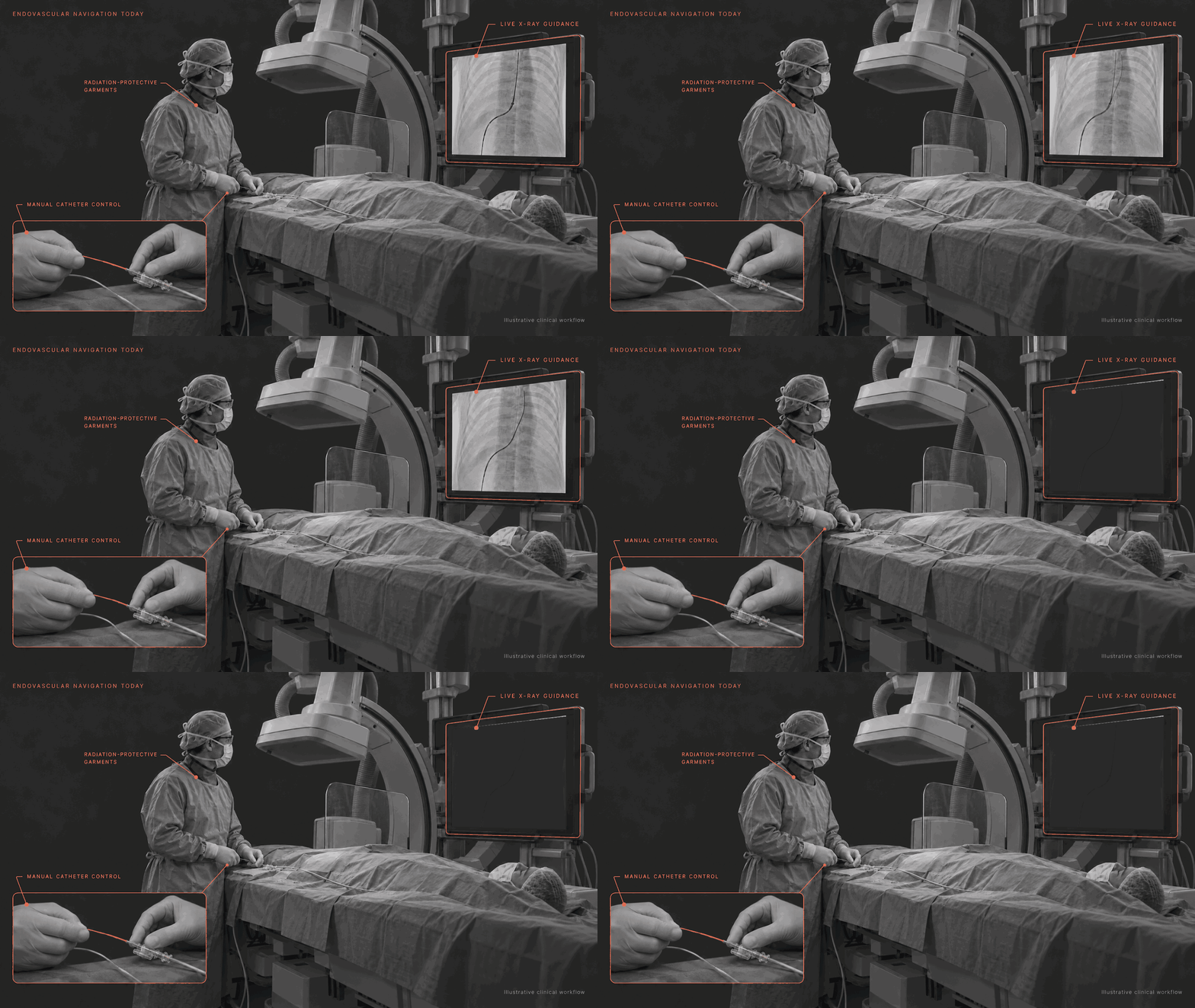
At a vessel branch point, advancing the instrument might guide it into the opening, cause it to buckle, press it against the vessel wall, or even cause the vessel to perforate. Each action changes the relationship between instrument and anatomy, and determines what can happen next. Therefore, successful navigation requires connecting what appears on the screen with tactile feedback from the instrument in the physician’s hands. It also necessitates anticipating how a movement at one end will affect the other. Modeling and predicting these complex physical mechanics in real time is the essence of spatial intelligence in surgical robotics.
A useful intelligent surgical system must understand and learn to adapt to that interaction between instrument and anatomy to help guide the next action. It must also anticipate the consequences of a given action, and use real-time feedback to assess what actually happened.
Broadly speaking, any spatially intelligent machine is defined by its ability to perceive, interpret, and interact with its environment, which in turn, depends on environmental observability. In mathematics and control theory, observability is a measure of how well the internal state of a system can be inferred from its external outputs. In endovascular navigation, relevant information includes three-dimensional geometry, deformation, contact forces, material properties, pressure, and flow. X-ray fluoroscopy projects a three-dimensional scene onto a two-dimensional image, providing valuable 2D information about instrument position. But higher-quality images alone do not directly measure many of the interactions that determine how the instrument will move–nor, what positive or negative consequences may occur from a given movement.
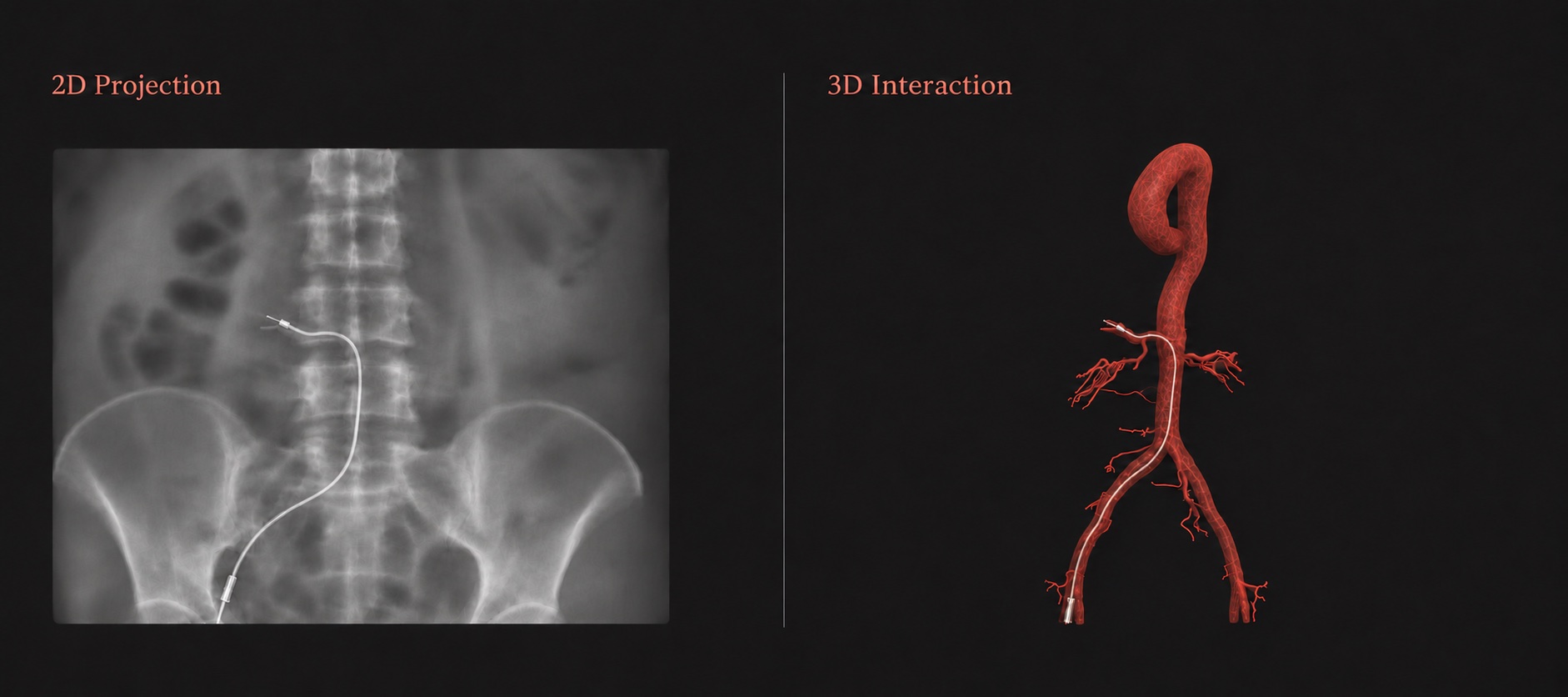
This is the intelligence problem we are working on at Mosaic.
Mosaic brings together sensing, simulation, robotic dexterity, and computation to investigate that question and make the relationship between instrument and anatomy observable. We make the intravascular environment visible - first to humans, and eventually, to machines.
Our first systems are deliberately physician-operated. The physician chooses the target and directs the instrument; Mosaic helps them navigate millimeter-scale domains with little margin for error in three-dimensions, with greater confidence and less dependence on X-ray imaging.
This collaboration also creates an opportunity to record observations, actions, and their consequences, gathering the experience from which more capable assistance can be developed. As we learn which observations reliably explain instrument behavior, we can build models that anticipate the consequences of an action. Over time, those models could support assistance with defined navigation tasks, with each capability evaluated before it is entrusted with greater responsibility.
Building these models requires data that captures the interactions that matter, with enough diversity to understand how they vary. A video may show where an instrument moved without revealing what it contacted, how it deformed, or why the operator stopped. More examples of the same incomplete observation may leave the underlying uncertainty unresolved.
Our data strategy therefore connects four environments:
- Simulation and synthetic data let us systematically vary anatomy, instrument properties, motion, and sensing conditions, with access to ground truth that is difficult to obtain during a procedure.
- Benchtop experiments let us measure real instrument behavior and identify where our simulations diverge from it.
- Preclinical studies introduce living physiology and the full procedural workflow.
- Clinical deployment, over time, can expose our systems to the diversity of patients, operators, and conditions they must ultimately serve.
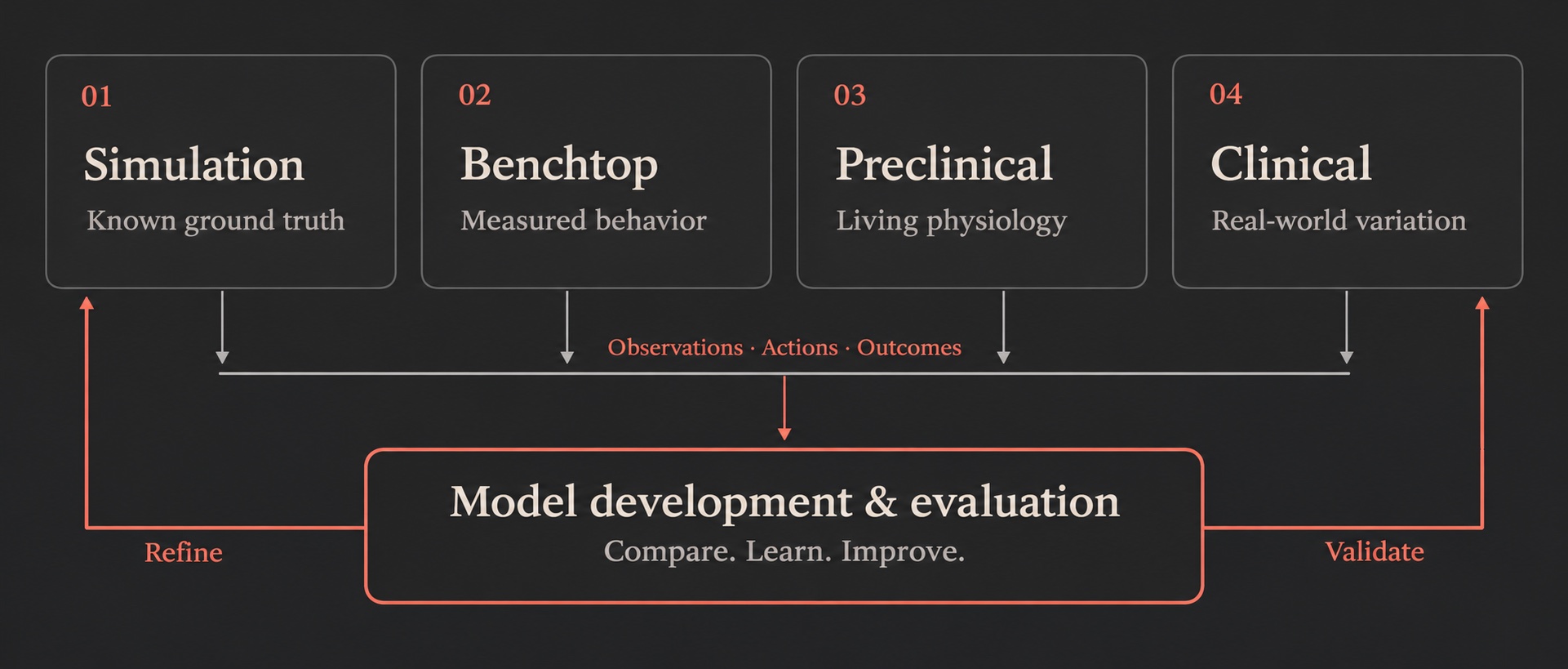
The value is in connecting these environments. A discrepancy observed on the bench can reveal a missing assumption in the simulation environment. A failure in living anatomy can identify the edge cases we need to recreate and test. Simulation allows us to subsequently vary that condition beyond the empirical samples we could practically collect. Together, these environments help us build, challenge, and refine our understanding of how instruments interact with the body.
The path to healthcare abundance
Mosaic’s ambition is to expand what can be treated through endovascular access by enhancing competence and democratizing access to frontier procedures, which together can help more physicians perform demanding procedures with confidence. Surgical machine intelligence offers a way for experience gained in one procedure to inform assistance in another, making expertise more transferable, outcomes more consistent, and high-risk procedures more feasible.
This creates a state of healthcare abundance. One where the capabilities of clinical teams grow, more patients can receive treatment, and the cost of delivering that care falls. At the end of the day, that’s our mission: augmenting human expertise to promote cheaper, higher-quality endovascular care for all who need it.